
Gymnastics After-School Club Payment System – How to Minimize Debt Administration?
When a gymnastics after-school club starts growing, the first thing...
EXOCLASS


In theory, the athletics season begins in September. In practice, it begins within 72 hours — from the moment registration for athletics training sessions opens. During a few intense days, the club experiences a level of traffic it won’t see again for the rest of the year.
In late August or early September, the enrollment wave begins. Parents often register not just one child, but two or even three, each in different groups. The phone keeps ringing, the inbox fills with questions, and the administrator tries to manually manage groups that are filling up by the hour.
Groups reach capacity within hours. In one group, two spots are still available; in another, it is already overbooked. If the athletics after-school club registration system is not prepared for this spike, chaos follows: duplicated spots, unclear payment statuses, and unconfirmed registrations.
It’s important to understand — the problem is not demand. On the contrary, demand is a strength. The problem arises when athletics after-school club management is not structured to withstand seasonal pressure.
An athletics after-school club registration system should not be designed for the “quiet months,” but for peak enrollment. Because the season is won not by the club that receives the most inquiries, but by the one that converts them into confirmed registrations most efficiently.
The seasonal enrollment period is a true stress test for every club. This is when it becomes clear whether your athletics after-school club registration system was built for stable day-to-day operations — or whether it is genuinely prepared for high traffic.
Most issues do not arise because of demand. They arise because of weak process design.
1. The registration form cannot handle peak traffic
When dozens of parents log in at the same time, the system begins to slow down. The form freezes, data gets duplicated, and errors appear. Parents submit the same registration multiple times because they are unsure whether it went through.
In this situation, registration for athletics training sessions stops being a smooth digital process and becomes a source of stress — both for families and for administrators.
2. Capacity limits are managed manually
If group capacity is adjusted manually or tracked in separate spreadsheets, inaccuracies are inevitable. One group may become overcrowded while another still has empty spots.
Without automatic limits, athletics after-school club management turns into constant balancing between overfilled and underfilled groups.
Peak season exposes these gaps immediately.
3. Payment is postponed “for later”
Parents complete the registration but decide to pay later. The spot appears reserved but is not actually confirmed. The administration must manually track who has paid and who has not.
If the athletics after-school club registration system does not clearly connect enrollment with payment status, some registrations remain unfinished — creating uncertainty and additional follow-up work.
4. Communication becomes fragmented
When real-time availability is not visible, parents begin asking the same question repeatedly: “Are there still spots available?”
Phone calls, emails, social media messages — all of this adds pressure to the administration. Instead of managing growth, the team spends time answering repetitive questions.
Seasonal enrollment is a process stress test.
If the system works only when traffic is low, it is not strong enough. An effective athletics after-school club registration system must be designed to perform better under pressure — not slower.
Optimizing seasonal enrollment does not simply mean having an online form. A form is only the surface. True optimization begins when your athletics after-school club registration system functions as a self-sustaining process — not as a tool that constantly requires administrative intervention.
During peak registration for athletics training sessions, every manual decision becomes a risk: errors, delays, or overfilled groups. That is why the system must handle key actions automatically.
An effective system should:
When these elements are in place, athletics after-school club management remains predictable even during peak traffic. The administrator no longer counts spots manually or tracks who “still needs to transfer payment.”
The key point is this: optimization is not about reacting faster.
Optimization means making fewer manual decisions during peak season.
When the system manages limits, confirmations, and payment statuses on its own, the registration surge becomes a controlled process rather than chaos.
Seasonal enrollment does not have to explode within a single week. It can be distributed strategically. That requires not only a strong athletics after-school club registration system, but also a clear action plan.
If all demand is compressed into the same 72-hour window, even a robust system feels the pressure. However, part of the peak can be reduced in advance through a structured early registration strategy.
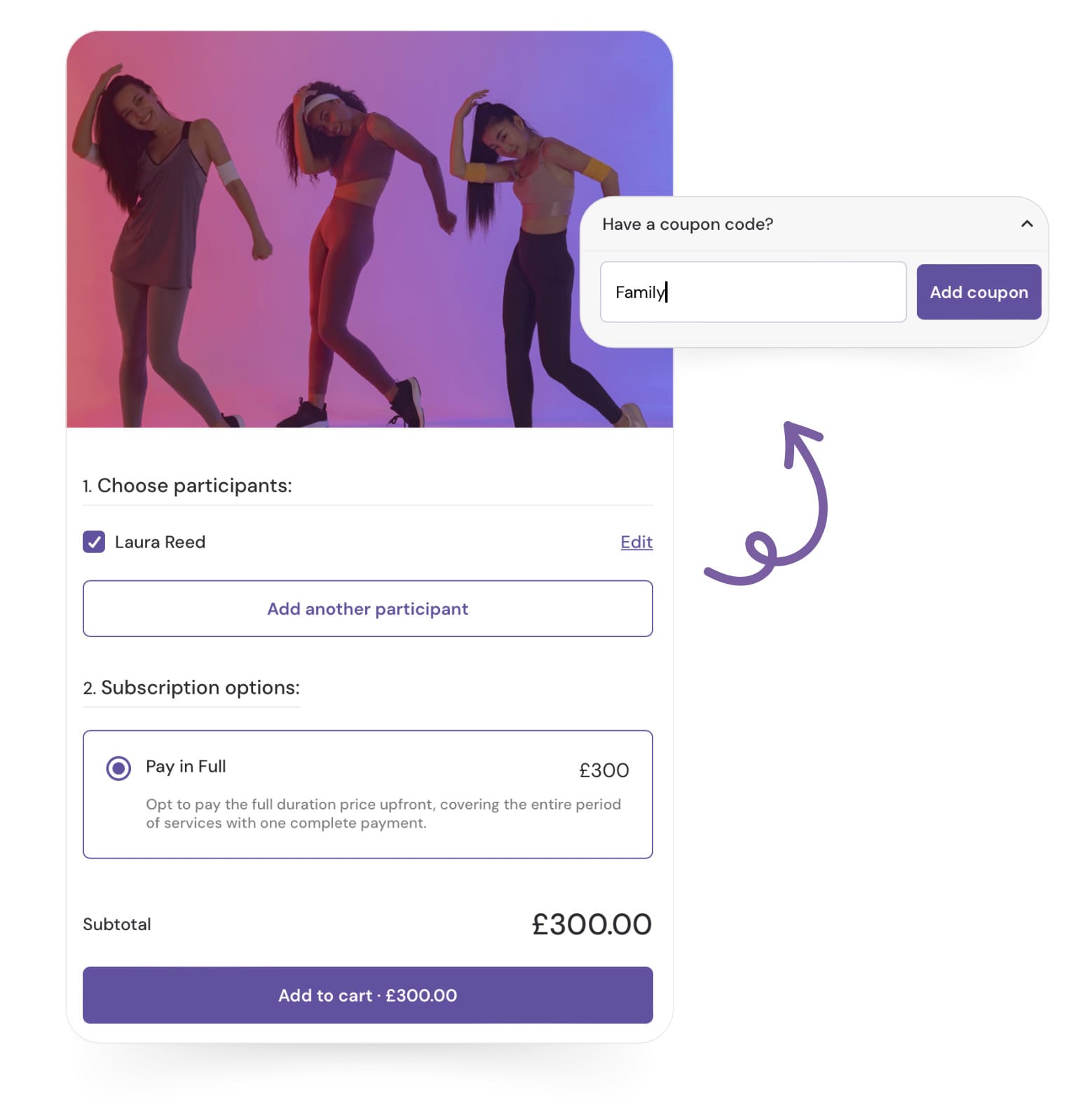
“Early bird” pricing. Offering a discounted early registration rate or added value (such as a guaranteed spot in a preferred group) encourages parents to commit sooner. This means registration for athletics training sessions begins before the official season launch. Traffic is spread out over time, and athletics after-school club management becomes more balanced and predictable.
Priority registration for existing members. Current members are the foundation of retention. Giving them early access helps to:
This approach allows clubs to fill part of their capacity in advance before opening enrollment to the wider audience.
Advance spot reservation. Allowing families to reserve a spot with partial or full payment provides clear visibility into future occupancy. If the athletics after-school club registration system supports reservation logic with automatic payment linking, the administration can immediately see which groups are close to full.
Automated reminders before registration opens. The system can send automated notifications to existing or potential members a few days before enrollment begins. This shifts the club from reacting to demand to managing it proactively. Parents are prepared, aware of the date and time, and the enrollment process becomes smoother.
The key point is this: the system must support these strategies.
If the athletics after-school club registration system does not allow flexible pricing, priority access, or payment-linked reservations, strategy remains only an idea.
Seasonal enrollment can be a chaotic surge — or a planned, structured campaign. The difference is not demand, but how the club organizes it.
Learn more about EXOCLASS registration features here.
Athletics rarely operates under one simple pricing model. The season follows its own rhythm: autumn launch, winter training blocks, spring competitions, summer camps. Each phase brings a different financial structure.
Most clubs run several models at the same time:
If an athletics after-school club registration system supports only one payment type, the administration starts creating exceptions manually. And every exception means more time, more adjustments, and a higher risk of mistakes.
An effective system should allow clubs to:
When registration for athletics training sessions is directly connected to the selected payment model, athletics after-school club management becomes predictable. The club leader sees not only the number of participants, but also the structure of expected revenue.
Seasonality should not mean financial uncertainty.
When payment logic is aligned with the season, peak enrollment becomes a planned phase — not a financial risk period.
Seasonal enrollment is not just a technical phase — it is the moment that reveals whether a club is truly ready to grow. EXOCLASS is designed as an athletics after-school club registration system that not only collects applications, but manages the entire season launch in a structured way.
Automatic capacity limits.
The system automatically closes a group once the predefined participant limit is reached. No more overcrowded groups or manual seat counting. This allows athletics after-school club management to remain clear and controlled — even during peak registration.
Integrated payments.
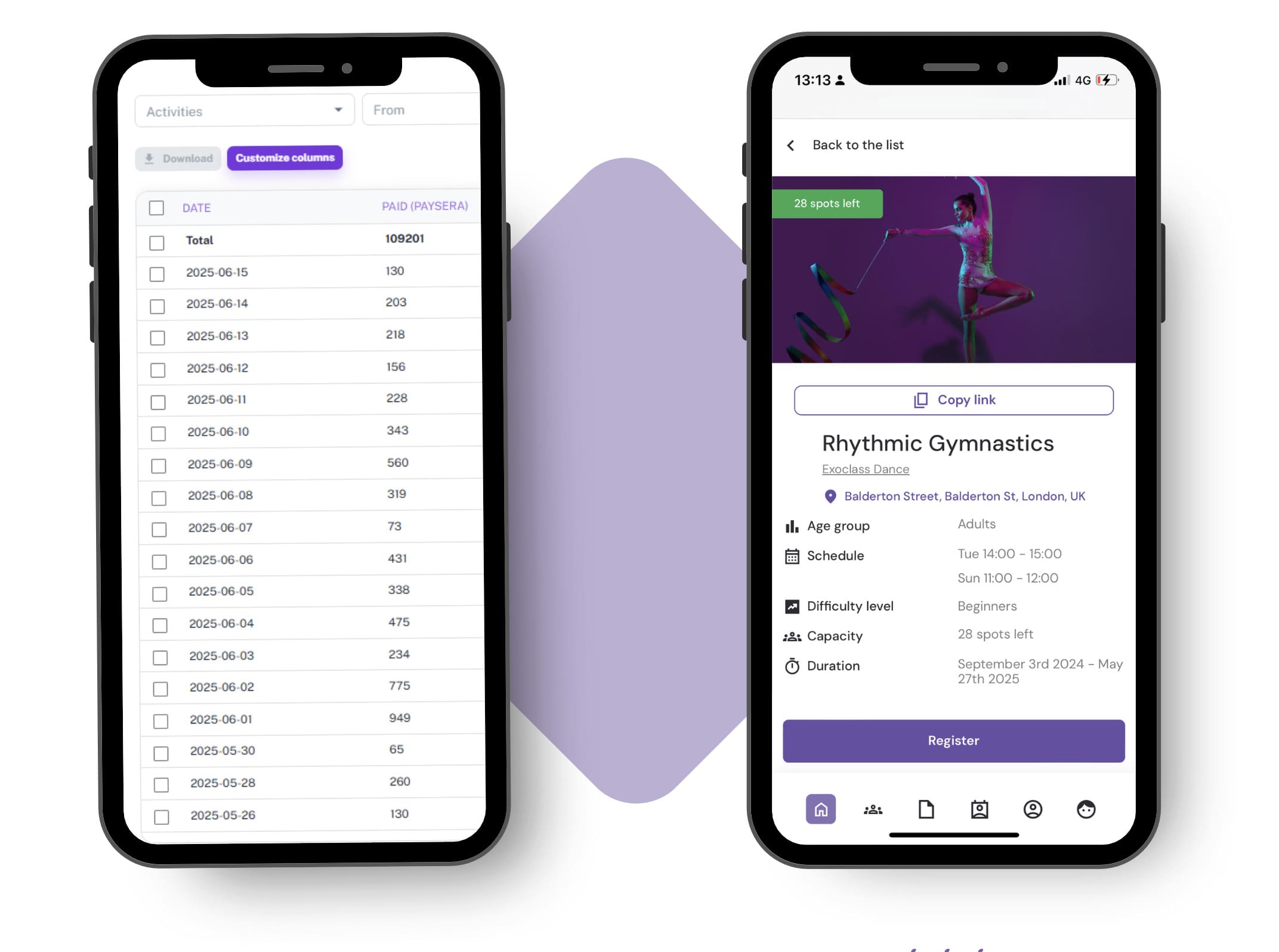
Registration for athletics training sessions can be directly linked to payment. Statuses update in real time, so the administration clearly sees which spots are confirmed and which are still pending payment.
Seasonal plans.
EXOCLASS supports monthly memberships, seasonal plans, and installment-based payment models. This makes it easy to structure finances according to the season’s logic and forecast revenue in advance.
Centralized participant management.
All data — registrations, payments, attendance — is stored in one place. The club manager sees the full seasonal picture instead of fragmented information.
Real-time analytics.
Occupancy rates, group balance, revenue trends — everything is available in one dashboard. Decisions are based on data, not intuition.
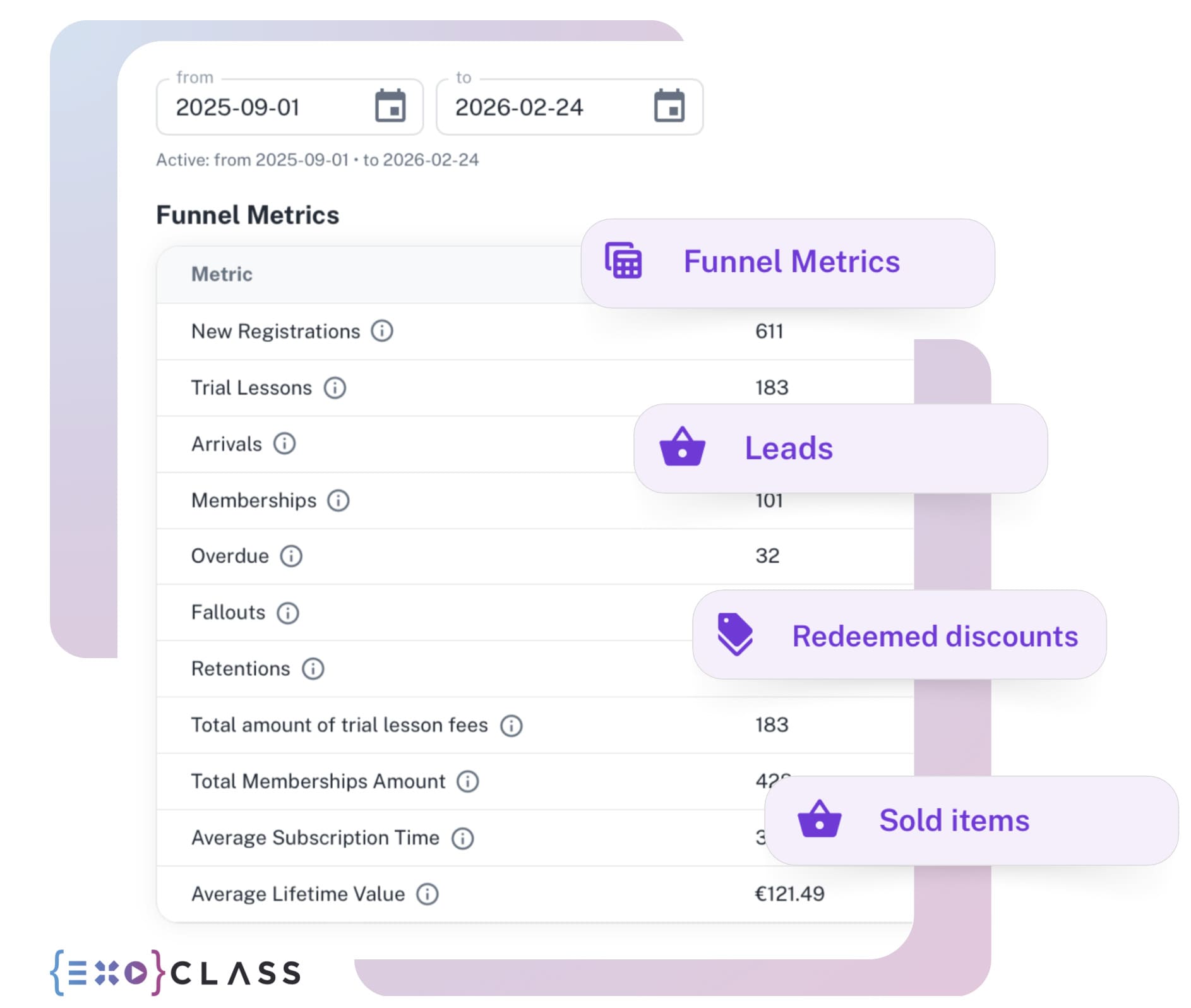
EXOCLASS is not just a tool to “fix registration.” It is a system that helps clubs prepare for the next season in advance — with clear capacity limits, structured payments, and predictable growth.
🚀 If you want your next registration season to be planned rather than chaotic, book an EXOCLASS demo and prepare for peak enrollment before it begins.