Basketball Club Administrative System – How to Evaluate System Quality and Reliability
EXOCLASS
Table of Contents
Most basketball after-school clubs start out simply. A few groups, one or two coaches, student registration through a basic form or message, and schedules managed in a spreadsheet. This model works as long as the organization remains small and processes can be handled manually.
But growth changes everything.
More groups are added. Different age levels emerge. Additional training sessions, tournaments, and camps appear on the calendar. The coaching team expands, and with it, the need for coordination. At this stage, basketball after-school clubs no longer resemble a small initiative—they begin operating as structured academies.
This is where the turning point becomes clear: the administrative workload starts growing faster than the organization itself.
Schedules begin to overlap. Payments are delayed due to a lack of clear tracking. Student registration becomes confusing when different groups are filled through different channels. Manual planning, which once worked well, becomes a weak link. Every mistake starts costing time, money, and—most importantly—reputation.
When parents receive inaccurate information or unclear reminders, trust declines. When coaches lack a structured system, the risk of chaos increases. At that point, it becomes evident that the issue is not the people—it is the structure.
This is when a basketball club administrative system stops being a technical choice and becomes a strategic decision. It determines whether the organization can continue growing in a stable and professional way.
A well-chosen after-school club management system centralizes processes by connecting student registration, payments, and scheduling into one unified structure. This means fewer errors, greater clarity, and more time to focus on what truly matters—developing young athletes.
For that reason, a basketball club administrative system should not be seen as a temporary solution or an additional expense. It should be viewed as a long-term investment in sustainable growth and organizational professionalism.
System Quality Begins with Process Clarity and Automation
When selecting a basketball club administrative system, it is essential to understand one key principle: quality is not defined by the number of features. Quality is defined by how the system performs in daily operations.
If processes still rely on manual work, additional spreadsheets, or constant supervision, even a modern-looking after-school club management system remains a superficial solution.
The main test is simple: does the system truly connect your processes?
A high-quality system should allow you to manage in one place:
student registration,
payments,
training schedules,
real-time group capacity.
If these areas operate separately, the organization continues to function in fragments.
It is also important to evaluate whether:
student registration confirmations are automated,
payment reminders are sent automatically,
administrators can instantly see which groups are full,
the likelihood of manual errors is reduced.
A high-quality basketball club administrative system must reduce workload—not simply shift it elsewhere.
The best measure of quality is not a technical description. It is much simpler: how many hours per month does the administration save?
If the system enables faster student registration management, clearer payment tracking, and fewer scheduling mistakes, it is doing its job. If chaos does not decrease after implementation, the problem is not the people—it is the choice of system.
When evaluating an after-school club management system, the right question is not, “How many features does it have?” but rather, “How much clearer have our processes become?”
That is where true quality begins.
Reliability Is Measured by Data Security and System Stability
When choosing a basketball club administrative system, it’s important to understand one thing: reliability is not just about whether the system “works.” Reliability means stability, security, and predictability—every single day.
Below are four essential criteria that help objectively evaluate the reliability of a system.
1. Data Security Must Be a Priority, Not an Add-On
All information related to students, payments, and training schedules should be stored centrally. If data is scattered across different tools or saved on individual staff members’ computers, the risk becomes too high. A reliable after-school club management system ensures that data is protected and accessible only through a secure, controlled environment.
2. Access Control Must Be Clear and Well Defined
Coaches should only see their own groups, schedules, and student information. Administrators should have a broader overview. When access is not properly differentiated, confusion increases and the risk of data breaches grows. Clearly managed user accounts are a strong indicator of system maturity and professionalism.
3. System Stability Must Be Consistent and Predictable
Frequent disruptions, slow performance, or technical issues directly impact daily operations. If student registration or payment tracking fails at critical moments, both processes and reputation suffer. A reliable basketball club administrative system must operate smoothly—without unexpected downtime or instability.
4. Long-Term Data Retention Builds Organizational Memory
It’s not just about today—it’s about history. Does the system allow you to archive seasons? Can you access past groups, payment records, and attendance trends? Long-term data preservation supports strategic planning and helps build decisions on real results rather than assumptions.
Reliability is part of your reputation. When the system runs smoothly, data is secure, and processes are clear, parents experience organizational transparency. And transparency directly builds trust in a sports organization.
That is why a basketball club administrative system should not be evaluated based on appearance, but on whether it ensures safe, stable, and consistent daily operations.
Reporting and Analytics – The Real-World Test of Quality
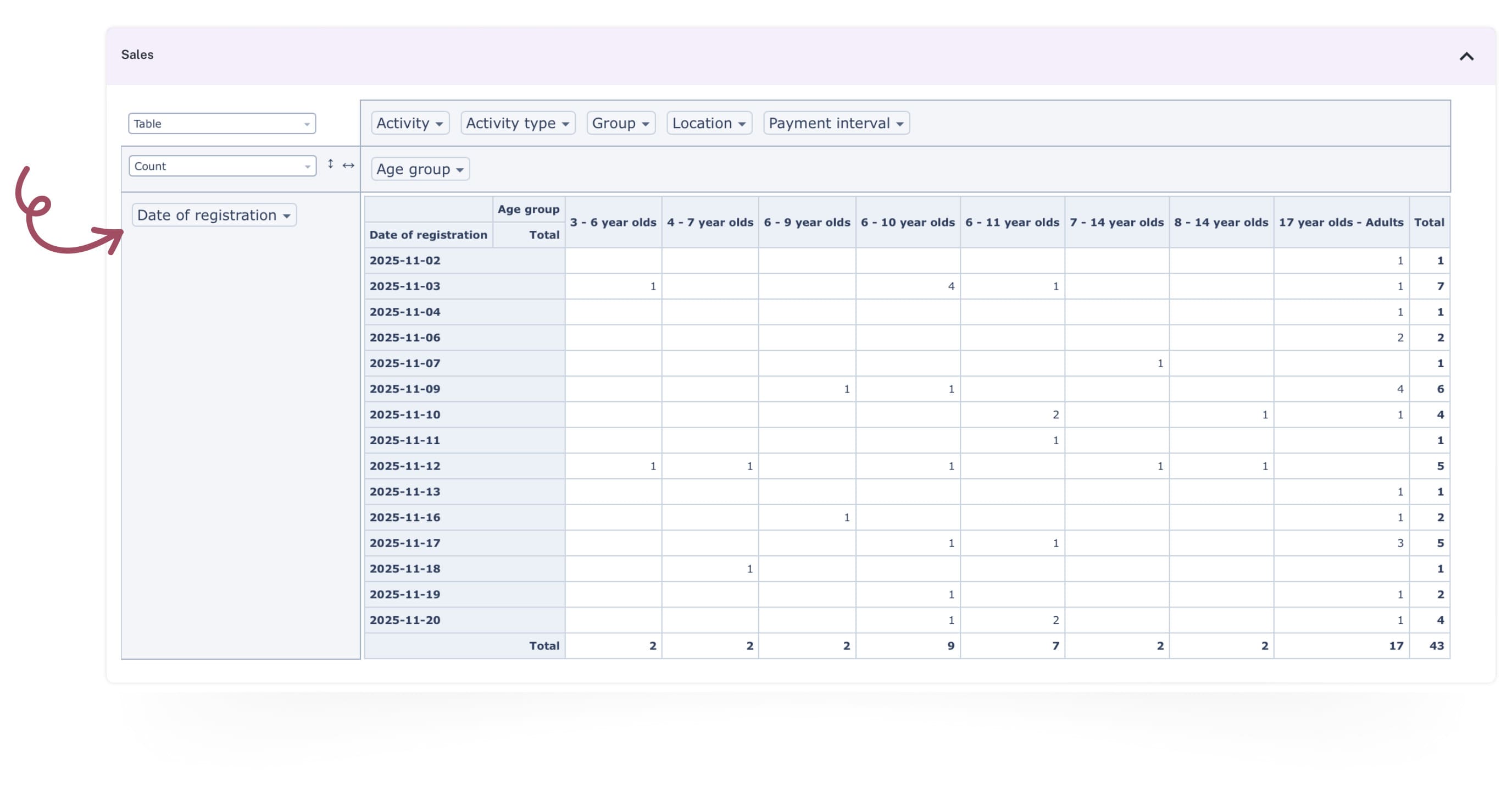
The true value of a basketball club administrative system becomes clear not in the registration window, but in the reporting dashboard. This is where you see whether the system is merely technical—or truly managerial.
If you cannot see the full picture, you cannot make accurate decisions.
A leader needs more than a list of who attended today’s practice. They need insight into trends, financial health, and long-term growth direction.
A high-quality after-school club management system should allow you to view in one place:
group capacity and available spot trends,
payment status—who has paid and who is overdue,
revenue distribution by program or season,
attendance patterns and their changes over time.
These metrics are not just numbers. They answer critical questions: Which groups are growing fastest? Which programs generate the most value? Where should communication be strengthened or schedules adjusted?
Without reporting, a system remains only a student registration tool. With reporting, it becomes the foundation of strategic management.
Read more about how to convert and attract more clients in this article.
When data is clearly visible, leaders make decisions based on facts—not intuition. This allows for confident expansion, targeted investment, and early risk detection. That is how a basketball club administrative system evolves from a technical solution into a true engine of organizational growth.
Scalability – Is the System Ready to Grow with Your Basketball Academy?
In the short term, almost any system can seem sufficient. The real test begins when your organization starts to grow. Scalability is the true measure of quality.
If you are managing five groups today, your system may run smoothly. But what happens when that number grows to ten or fifteen? Will your basketball club administrative system maintain the same clarity, or will processes begin to slow down and become more complicated?
When evaluating long-term potential, it is worth asking a few essential questions:
Will the system remain just as efficient when the number of groups doubles?
Can new coaches be added quickly with clearly defined access levels?
Are different seasons, tournaments, and additional programs managed within one unified structure?
Can payment models be adapted to different situations—from monthly fees to one-time charges?
A scalable after-school club management system must allow growth without creating additional administrative chaos. It should not require new spreadsheets, extra tools, or complex workarounds every time the organization expands.
An administrative system should support expansion—not limit it. If growth creates more problems than opportunities, it is a sign that the chosen solution is not strong enough.
When evaluating a system, it is important to think not about today, but about tomorrow. Scalability is not an optional feature—it is the key indicator of whether a system is truly prepared to become a long-term growth partner for your basketball academy.
Practical Questions to Ask Before Choosing a System
When selecting a basketball club administrative system, what matters most is not how impressive it looks in a presentation, but how it will perform in your daily operations. The decision should be based on clear criteria—not promises.
Before making your final choice, ask yourself:
Will the system genuinely reduce my administrative workload? If processes remain just as complex—only moved to another platform—the value will be limited.
Does it ensure data security and clear access control? Student information and payment data must be protected and responsibly managed.
Will I have clear, easy-to-understand reports? Without analytics, an after-school club management system remains only a registration tool.
Will I be able to grow without replacing the system in a year? If you already see limitations today, they will only increase as you expand.
Does the system connect student registration, payments, and communication in one place? Fragmented solutions create extra work and increase the risk of errors.
These questions help evaluate not only functionality but long-term value. A high-quality basketball club administrative system should become the foundation of your organization—not a temporary solution.
Conclusion – A High-Quality Basketball Club Administrative System Is Not an Expense, but Growth Infrastructure
Choosing the right system requires a shift in perspective. A basketball club administrative system is not an additional cost—it is an investment in sustainable growth.
It must be:
reliable—so processes run without disruption;
clear—so administrators and coaches work in a structured way;
secure—so student data and payments are protected;
strategically valuable—so leaders can make decisions based on data, not assumptions.
Short-term savings may seem attractive. But choosing a limited or fragmented solution often costs more in the long run—through lost time, damaged reputation, and missed opportunities. When a system cannot support growth, the organization begins to limit itself.
An administrative system should become the backbone of the organization. It must connect student registration, payments, communication, and analytics into one clear structure. Only then can basketball after-school clubs grow without additional chaos.
That is what a modern after-school club management system should provide—not just administration, but structured and strategic expansion.
If you are looking for a system that grows with your academy, EXOCLASS was built for exactly that purpose—to serve not merely as software, but as a solid foundation for long-term growth.