In recent years, customer behavior has changed fundamentally. The market now offers more choices than ever, while patience for chaos, unclear processes, and slow responses has significantly decreased. Customers expect clear information, smooth workflows, and fast reactions from the very first contact. As a result, customer service in after-school clubs is no longer an optional add-on—it has become one of the most important competitive factors.
More and more often, even strong clubs with high-quality programs lose customers not because of the activities themselves, but because of the experience surrounding them. Unclear student registration, a confusing after-school club registration process, delayed responses, or administrative mistakes quickly create distrust. For customers, this is a signal that the organization may not be ready to grow or ensure stability, even if the educational content itself is valuable.
It is essential to understand that customer service is not a separate “administrative function.” It is an integral part of the entire service, covering every customer touchpoint—from the first inquiry to ongoing communication, payments, and day-to-day decision-making. When these processes are unclear or inconsistent, even the most dedicated team begins to feel constant pressure. This is where a reliable after-school club administration system becomes critical, helping ensure structure, clarity, and calm operations within growing after-school club programs.
In this article, we will show why customer service should be seen as a strategic foundation rather than a technical detail. We will explore how to build a customer service system that supports growth, prevents chaos, and allows an after-school club to scale with confidence—without constant administrative stress.
Customer Service as the Entire Experience, Not Just Responses
Customer service in after-school clubs begins long before the first class—or even before after-school club registration. It starts the moment a customer first encounters information about the club, submits an inquiry, or tries to understand whether the program is the right fit. At this stage, the first impression is formed, and it often determines whether the customer will take the next step.
Customer service includes every touchpoint: the initial inquiry, student registration, the payment process, day-to-day communication, updates about changes, and even the cancellation process. None of these stages are secondary. If confusion or disorder appears at any point, it spills into the overall experience and begins to undermine trust in the entire organization.
This is why seemingly small details matter so much. An unclear email, a delayed response, or inconsistent payment information sends a signal that internal processes lack structure. Over time, administrative disorder stops being an internal issue and becomes a direct cause of customer dissatisfaction. This is where an after-school club administration system becomes especially important—it helps manage processes and ensure a consistent experience within growing after-school club programs.
The Customer Journey in an After-School Club: Where Things Most Often Break Down
Customer service issues tend to surface at specific stages of the customer journey. The first contact is one of the most sensitive points—here, not only speed matters, but also tone and clarity. If a customer does not receive a clear answer or has to chase information, trust begins to erode before the relationship even starts.
The second critical point is after-school club registration. Too many questions, unclear steps, or manually handled student registration create the impression that processes are not fully thought through. Even if the club itself is strong, a complicated registration process often becomes the reason a customer chooses a simpler alternative.
In daily interactions, customers value easy access to information and predictability. They want to know where to find answers, when they will receive updates, and what to expect next. Finally, even the cancellation moment is an important test of customer service. How an organization responds when a customer decides to leave often determines whether they walk away with a positive impression and whether they will recommend the club to others.
Slow, Fragmented, or Chaotic Communication
One of the most common reasons student registration fails to convert is delayed communication. Customers often compare several options at the same time, so waiting days for a response feels like silence. Even a short but clear reply delivered on time can be the deciding factor between one club and another.
Problems grow when information is fragmented. One message is sent by email, another by text, and a third explained over the phone. Customers struggle to understand which information is final, while administrators lose track of who has already been answered. This leads to situations like “we replied, but we’re not sure to whom” or “we thought this was already handled,” which directly damage customer service in after-school clubs.

In growing after-school club programs, this type of communication becomes especially risky, as mistakes begin to repeat. Without clear structure and a unified system, even strong teams gradually shift from proactive planning to constant firefighting.
Manual Process Management as a Hidden Risk
Registration and payments are the most sensitive stages of customer service. When after-school club registration, payment tracking, and contract management are handled in different places, mistakes become unavoidable. One piece of information lives in a spreadsheet, another in email threads, and a third in an administrator’s memory. For customers, this usually results in simple but frustrating questions: Is my registration confirmed? Was my payment received? Do I need to do anything else?
Payment-related issues are particularly delicate. A late invoice, unclear payment status, or incorrect amount quickly erodes trust. Even minor mistakes signal deeper organizational disorder. In these situations, an after-school club administration system is no longer a convenience—it is a necessity, providing real-time clarity on registrations, payments, and overall status.
As organizations grow, manual process management inevitably begins to break down. More customers mean more payments, more exceptions, and more edge cases. Administrative time shifts from delivering quality service to fixing errors. This increases team stress and directly impacts the customer experience.
Emotional Reactions to Customer Problems
When processes lack clarity, customer issues become more frequent—and emotional pressure rises. In these conditions, criticism is often perceived as a personal attack rather than a signal of a broken process. Responses turn defensive, explanations become unclear, and the underlying issue remains unresolved.
Emotional reactions often overshadow problem-solving. Instead of asking, “Which part of the process isn’t working?” teams fall into justification or blame-shifting. Over time, this further weakens customer service in after-school clubs and deepens dissatisfaction.
Clear processes and a structured after-school club administration system help reduce emotional strain. When administrators rely on data rather than memory or assumptions, issues are resolved more calmly and efficiently. This allows teams to refocus on what truly matters—creating a reliable, predictable customer experience that supports growth instead of holding it back.
When the Entire Experience Rests on One Administrator’s Shoulders
Many after-school clubs rely on one or two people to carry customer service on their own. While this approach may work in a small organization, it quickly becomes fragile as the club grows. Staff turnover, burnout, or simply an increasing workload immediately affects the customer experience. When customer service in after-school clubs depends on a specific individual, stability becomes a matter of chance rather than a reliable standard.
An even bigger issue arises when critical information lives “in people’s heads” instead of in a system. Registration exceptions, payment arrangements, or communication details are not recorded centrally, so when an employee changes, customers are forced to explain everything all over again. This is frustrating for customers and slows down growth—each new customer becomes an additional burden instead of a natural part of expansion.
For growing after-school club programs, moving away from person-dependent service toward clearly defined processes is essential. At this point, an after-school club administration system is no longer optional—it becomes core infrastructure.
When Customers Know What to Expect, Tension Disappears
One of the biggest sources of stress for customers is uncertainty. When will the after-school club registration be confirmed? Is student registration actually complete? When will payment details or schedule updates arrive? If these answers are unclear, customers begin to feel uneasy—even if they genuinely like the club itself.
Clear processes eliminate this tension. When it is defined when, where, and how customers receive information, communication becomes predictable. Customers no longer need to constantly write or call for updates, and teams no longer have to figure out what was sent and to whom. This directly improves customer service in after-school clubs.
Standardized solutions for common situations do not mean robotic communication. They mean that every customer receives clear, consistent information. As a result, emotional pressure decreases, the risk of errors drops, and conflicts become far less likely.
How Technology Frees Time for Human Interaction
Automation is often seen as a threat to personal connection, but in practice it does the opposite. Automatic after-school club registration confirmations, payment reminders, and informational messages give customers a sense of security—they know the process is moving forward and nothing will be lost. This reassurance is one of the strongest foundations of trust.
At the same time, technology removes repetitive, draining tasks from the team’s workload. Instead of answering the same questions over and over again, staff gain time for meaningful conversations, complex situations, and process improvement. In this context, an after-school club administration system becomes a calm background support rather than an added source of stress.
When automation is used intentionally, daily operations involve less firefighting and more planning. This allows after-school club programs to grow with confidence—without sacrificing customer experience or pushing teams to their limits.
A Complete Customer History in One Place
High-quality customer service in after-school clubs starts with clear, accessible information. EXOCLASS allows administrators to see the entire customer history in one place: after-school club registration, payments, attendance, contracts, and all previous actions. There is no need to search through emails or spreadsheets—everything is available in real time.
This enables teams to respond to customer questions accurately and without guesswork. When a customer asks about a payment, registration status, or attendance, the answer can be provided immediately, without additional checks. This level of clarity builds trust and shows that the after-school club program is well managed and in control of its processes.
Automated Communication and the Customer Account
A large share of tension in customer service comes from uncertainty: Is the registration confirmed? Was the payment received? Where can I find the contract? EXOCLASS addresses this through automated communication and a dedicated customer account.

Customers receive registration confirmations, reminders, and important updates automatically, without manual involvement from the administration team. Through their customer account, they can independently view payment history, attendance records, and contracts. This significantly reduces the need to call or email about everyday questions and helps customers feel confident and informed.
For administrators, this means fewer repetitive inquiries and more time to focus on situations where real human attention is needed. In this way, the after-school club administration system supports a calmer, more stable day-to-day workflow.
Simple Registration and Secure Payments
One of the most sensitive moments in the customer experience is student registration and payment. If this process is complicated or unclear, customers often drop out before participation even begins. EXOCLASS makes it possible to create a clear and simple after-school club registration process, where customers know exactly what to do and when.
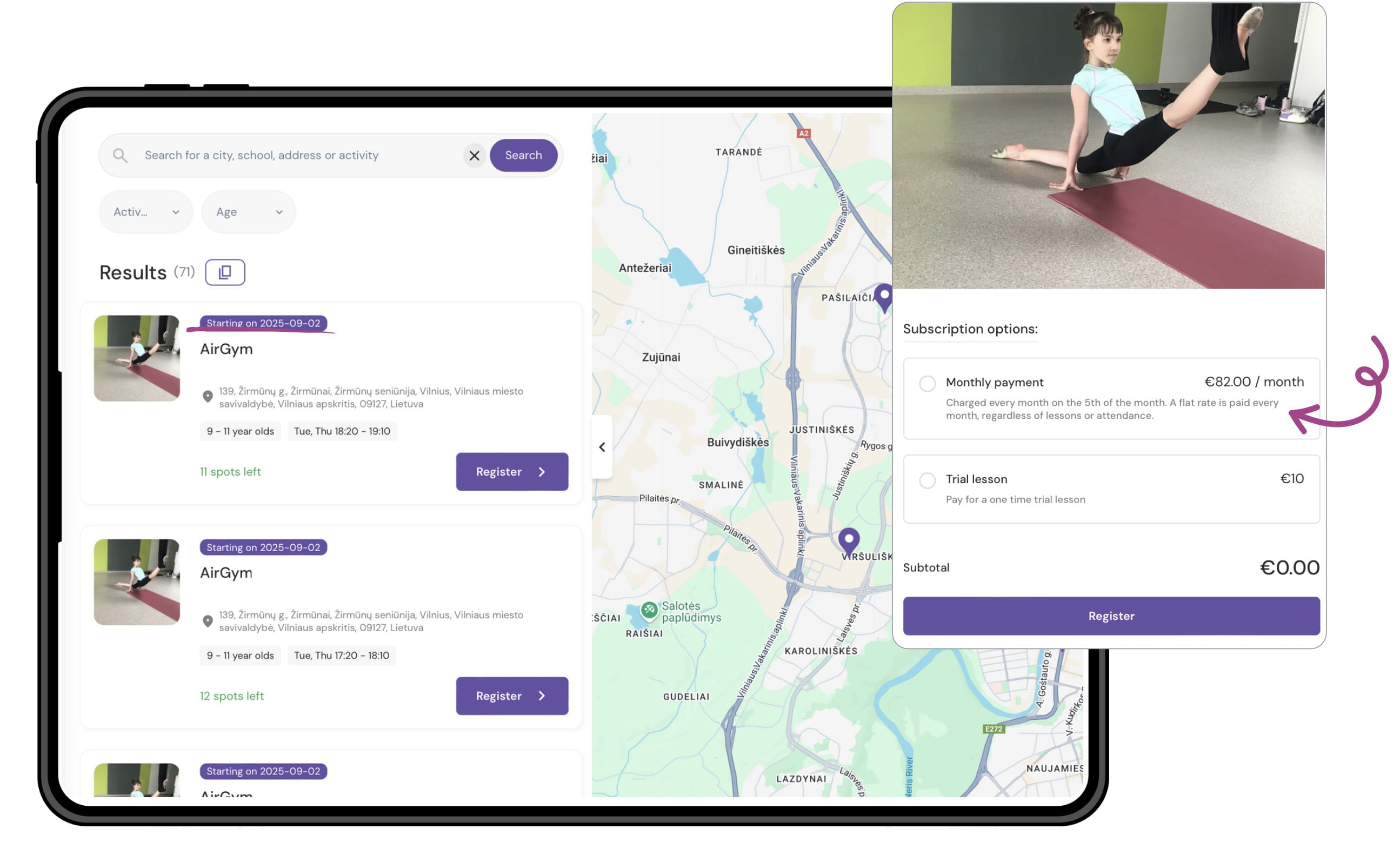
Registration happens in one place, without extra emails or manual confirmations. Payments are processed securely, and their status is clearly visible to both customers and administrators. This reduces errors and prevents frustration related to invoices or unclear payment situations.
With its advanced after-school club registration page, EXOCLASS turns customer service into a simple, transparent, and predictable process—one that supports growth and allows after-school club programs to scale without added chaos.
Read more about the EXOCLASS registration process here.
Great customer service in after-school clubs often goes unnoticed when everything runs smoothly. Yet clear, calm processes cost far less in the long run than constant error correction, rushed responses, and daily firefighting. When registration, payments, and communication are well organized, organizations save not only time but also emotional energy—for both their teams and their customers.
Stable customer service builds trust, and trust turns into loyalty and recommendations. Customers who clearly understand how everything works are less likely to leave, more likely to return, and more willing to recommend the club to others. In this way, customer service becomes not an extra effort, but a natural driver of sustainable growth within after-school club programs.
The key message for leaders is simple: customer service is not a minor administrative detail. It is growth infrastructure. Without it, even strong content and excellent instructors eventually begin to falter as the overall experience becomes unpredictable.
That is why growing after-school club programs should choose systems that create clear processes, reduce chaos, and support calm, confident growth. When customer service becomes a system rather than an improvisation, growth stops being a challenge and becomes a natural next step.
If you want to see how this works in practice, book an EXOCLASS demo and discover how customer service can become your growth infrastructure—not your weakest link.