Math School Administration System – What Criteria Help Evaluate Whether a System Is the Right Fit?
EXOCLASS
Table of Contents
At first glance, running a math school may seem straightforward: classes follow a schedule, students gather into groups, and teachers lead lessons. In reality, however, managing such an organization is far more complex. Administrators often need to coordinate multiple groups at the same time, students of different skill levels, teachers’ working hours, and constantly changing class schedules.
Math schools frequently work with students who have very different levels of preparation. Some are just beginning to strengthen their fundamental math skills, while others are preparing for exams or even math competitions. As a result, several programs and courses often run simultaneously, designed for different grades or ability levels. This structure requires clear organization, as each group progresses at its own pace and follows a different curriculum.
Administrative complexity increases further due to learning cycles. Math courses are often organized in semesters or longer program phases. This means administrators must plan not only individual lessons but the entire learning journey—from the initial registration to the completion of the course.
Problems typically arise when different processes are managed separately. If math after-school club registration takes place on one platform, class schedules are stored in separate files, and payments are managed elsewhere, the organization quickly encounters fragmented information. In such situations, it becomes difficult to track group capacity, plan courses effectively, or manage administrative processes efficiently.
For this reason, math schools need a clear operational structure. An effective math school administration system should bring together math after-school club registration, lesson scheduling, math school student management, and payments into one unified process. When all these elements function within a single math after-school club management system, administrators can manage operations smoothly and focus more on what matters most—delivering high-quality math education.
Registration: The First Test of an Administrative System
Registration is the first moment when a student and their parents encounter the organizational structure of a math school. Even before the first class begins, the registration process reveals how clearly and professionally the entire system operates. For this reason, math after-school club registration should not be just a simple form for collecting data—it should be fully integrated into the broader math school administration system.
In math schools, students often study at different levels. Some focus on strengthening their foundational math skills, while others prepare for exams or participate in advanced programs. Because of this, courses presented during registration should be clearly organized by grade level or mathematical proficiency. Such a structure allows students to choose the right program from the start and reduces the need for administrators to manually adjust registrations later.
Offering online registration 24/7 allows parents to enroll their children at any convenient time, regardless of administrative office hours. This becomes especially important during periods of high demand, such as before a new semester or at the start of the academic year. When the registration process is centralized, math school student management becomes much clearer, as administrators can monitor new student enrollments in real time.
Some math schools also incorporate placement tests or diagnostic questionnaires into the registration process. This helps evaluate a student’s skill level more accurately and assign them to the most appropriate group. Registration for semester-based courses also helps plan the long-term learning structure and ensures more stable group formation.
An effective math after-school club management system should allow administrators and parents to:
choose a math course based on grade or skill level
see available spots in groups in real time
reserve a place in a selected group online
receive automatic registration confirmation
When registration is designed this way, it becomes more than just an administrative step. It acts as a structured student allocation mechanism that immediately directs students to the most suitable course and ensures that the entire math school administration system operates smoothly from the very first interaction.
Groups and Levels: Math Education Requires a Clear Structure
Math education is almost always built on a clear learning progression. Unlike some other activities, it is essential that students learn in groups that match both their knowledge level and academic goals. For this reason, a math school administration system must ensure that students are assigned to the appropriate groups already at the registration stage.
In most math schools, groups are typically formed either by grade level or by mathematical proficiency. In the early grades, the focus is often on building fundamental skills and developing logical thinking. In higher grades, students encounter more complex topics and more intensive preparation for exams. Because of this progression, math after-school club registration should guide students directly to the program that best fits their level.
In addition to standard programs, math schools often offer specialized courses. These may include olympiad preparation programs for highly motivated students, additional exam-preparation groups, or advanced courses designed for deeper mathematical understanding. Such variety in course offerings requires a clear structure, since each program follows a different pace and curriculum.
Problems arise when a registration system cannot distinguish between these levels. If all students register for the same general groups, administrators must manually review registrations and move students to the appropriate programs. This makes math school student management more complicated and increases the likelihood of organizational errors.
For this reason, an effective math after-school club management system should function as a filtering mechanism. It should display only those groups and courses that match the student’s grade, skill level, or learning goal. When this structure works directly within the registration process, the entire math school administration system becomes clearer, and student placement happens smoothly from the very first step.
Ease of Use and User Experience
When developing or evaluating a math school administration system, one of the most important criteria is ease of use. Even a highly functional system can become ineffective if it is difficult to use in everyday operations. A math after-school club management system should be designed so that all users can quickly understand how it works and easily access the information they need. A well-designed system helps manage processes more efficiently, reduces administrative workload, and supports the smooth organization of a school or club.
The key aspects of usability include an intuitive user interface, clear navigation, fast access to information, and minimal learning time. The system should be structured so that core functions—such as math after-school club registration, class schedules, or math school student management—are easy to find and understand. This is particularly important when the system is used daily by people with different levels of technical experience.
When evaluating user experience, it is important to consider the main groups of system users.
Administration. Administrative staff are the primary users of the system because they are responsible for coordinating the organization’s overall operations. For them, a math school administration system must make it easy to manage student data, create groups, organize class schedules, and monitor payments. A well-designed system allows administrators to handle math school student management efficiently, quickly locate necessary information, and reduce the amount of manual work required.
Teachers. For teachers, the administration system should be simple and clear so that technology does not interfere with their primary responsibility—teaching. Through the math after-school club management system, teachers should be able to view their class schedules, student lists, attendance records, and student progress. A convenient system allows teachers to focus more on the learning process rather than administrative tasks.
Students. Although students usually interact with only part of the system’s functionality, it is still important for them to easily access information about class times, groups, or their learning progress. A clear and user-friendly system helps students better organize their schedules and understand their academic progress. This is particularly relevant in math schools, where monitoring student development is an important part of the learning process.
Parents. Parents often use the system to enroll their children in programs and track information about their learning. For this reason, math after-school club registration must be simple, clear, and quick to complete. Parents should be able to easily find information about groups, schedules, pricing, and the registration process. A convenient registration experience not only improves user satisfaction but also encourages more parents to use digital services.
It is important to emphasize that overly complex systems often become ineffective. If users need significant time to learn how to use a system or frequently encounter technical difficulties, staff may look for alternative solutions or return to manual processes. For this reason, when developing a math school administration system, user experience should be kept as simple and intuitive as possible.
A strong user experience directly affects the effectiveness of the system. A clear and convenient math after-school club management system allows administrative tasks to be completed faster, reduces the likelihood of errors, and improves communication between administrators, teachers, students, and parents. Because of this, ease of use is one of the most important criteria when evaluating whether an administrative system is suitable for a math school.
EXOCLASS Math School Administration System
A modern math school administration system should not only simplify administrative processes but also support organizational growth, improve student management, and ensure a smooth experience for all system users. One solution designed specifically for educational organizations is EXOCLASS—a specialized platform built for clubs, academies, and a wide range of learning organizations.
One of the key strengths of EXOCLASS is that the platform is designed to cover the essential administrative needs of educational organizations.
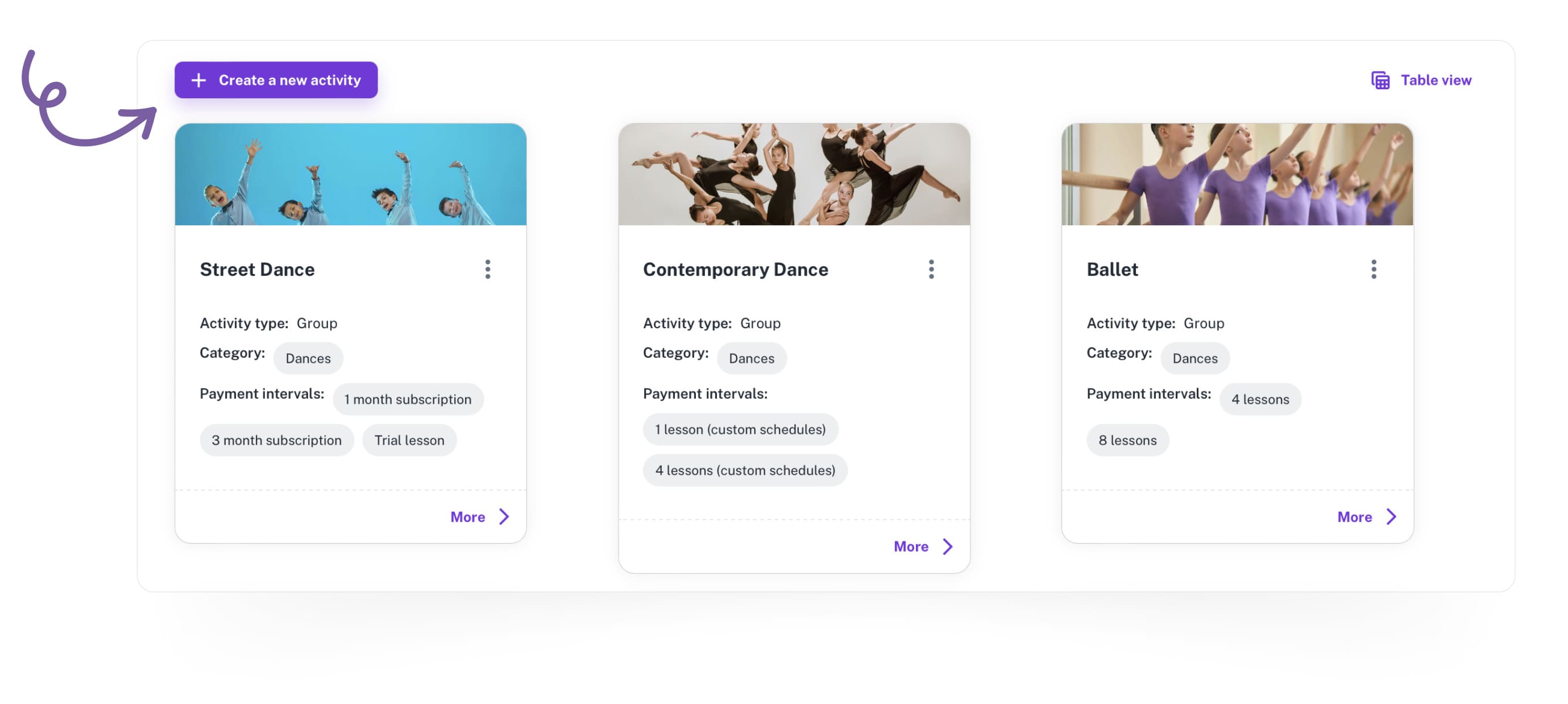
Convenient math after-school club registration for parents. EXOCLASS makes it possible to create a clear registration page where parents can select the most suitable math club based on the student’s age, level, or class schedule. All relevant information about courses is presented in one place, making the registration process simple and fast.
Centralized math school student management. The system allows administrators to see all students, their groups, attendance records, and other important information in a single platform. This helps manage student data efficiently and perform administrative tasks more quickly.
Class schedule and group organization. EXOCLASS enables schools to easily plan class schedules, manage groups of different levels, and monitor teachers’ workloads. This is especially important for math schools that run multiple programs at different levels.
Automated payments and financial management. The platform helps manage course payments, track transactions, and generate financial reports. This reduces the administrative workload and minimizes the risk of errors.
Clear and easy-to-use interface. EXOCLASS is designed to be convenient for administrators, teachers, and parents alike. Its intuitive structure allows users to quickly find the information they need and perform key actions without unnecessary complexity.
In this way, EXOCLASS functions as a comprehensive math after-school club management system that helps organizations not only manage daily operations more efficiently but also improve the overall experience for both students and parents.
Try EXOCLASS in Your Math School
If you are looking for a reliable and user-friendly math school administration system that helps organize operations, manage students, and simplify math after-school club registration, EXOCLASS is worth considering.