Music School Registration System – How to Simplify Student Allocation to Teachers?
EXOCLASS
Table of Contents
At first glance, it may seem that registration is the most important process in a music school. However, the real challenge lies not in registration itself, but in coordination—between students, teachers, instruments, and schedules. Even a modern music school registration system will not eliminate chaos if the allocation logic is not clearly defined.
A music school includes different instruments, levels, and age groups. Individual lessons require a different planning structure than group classes, and teachers’ specializations and working hours often limit available options. When schedules do not align with students’ availability, manual student management quickly becomes a source of errors and wasted time.
As the number of students grows, complexity increases rapidly—each new registration requires additional coordination between the teacher, the schedule, and the status of music school invoice payment. That is why allocation should be treated as a logistical task, and a music after-school club system as operational infrastructure—one that enables strategic process management instead of constant problem-solving.
Where the Process Breaks: Common Allocation Mistakes
Before discussing solutions, it is essential to identify the weak points. In many schools, the issue does not stem from lack of effort or competence, but from a fragmented structure. When a music school registration system is not fully integrated with scheduling, finances, and student management, allocation becomes improvisation rather than a controlled process.
One of the most common situations is imbalance: some teachers are overloaded while others have half-empty schedules. Without clear visibility into workload distribution, a music after-school club system cannot balance demand effectively. This leads not only to burnout risk but also to lost revenue, as existing capacity remains underutilized.
Another frequent issue is the disconnect between registration and the actual timetable. A student registers for a time slot that appears available in theory but is already reserved in practice—or does not match the student’s level. In such cases, administrators are forced to manually adjust and negotiate, slowing the entire process.
Students are often assigned based on available time rather than appropriate level or teacher specialization. While this may solve an immediate scheduling issue, it can negatively affect learning quality and long-term satisfaction. The problem is further compounded when registration occurs without confirmed music school invoice payment—time slots are reserved, but payment is not completed, creating financial and operational risk.
Finally, information is frequently stored across multiple files or systems: registrations in one place, schedules in another, payments elsewhere. This fragmentation complicates student management and increases the likelihood of errors. That is why improvement must begin with identifying where the process breaks—only then can a music after-school club system be built to function reliably and strategically.
Registration System as an Allocation Algorithm
An effective music school registration system should not function merely as a data collection form. It must operate as a filtering and allocation mechanism that guides students in the right direction even before administrative involvement. In other words, the registration page should act as a pre-selection filter—not a source of additional manual work.
For this to happen, the registration structure must be designed strategically.
• The registration form must collect more than just a name and time slot
A basic contact form is not enough. The system should gather:
the selected instrument
the student’s level (beginner, intermediate, advanced, etc.)
previous experience
preferred lesson schedule
This information allows the system to automatically narrow down suitable teacher options. It is the first step toward efficient student management and structured allocation.
• The system must filter only teachers who meet the criteria
Once the data is collected, the music after-school club system should automatically display only teachers who:
teach the selected instrument
work with the appropriate level
have available time slots
This prevents mismatches and significantly reduces the need for manual verification by administrators.
• Automatic display of available time slots
Instead of showing a general timetable, the system should present only truly available slots that match all selected criteria. This prevents conflicts between registration and the actual schedule. Real-time updates ensure that two students cannot book the same time slot simultaneously.
• Payment confirmation as a condition for final allocation
It is essential that music school invoice payment is integrated directly into the registration flow. A lesson slot or teacher assignment should only be confirmed once payment is completed. This prevents “reserved but inactive” bookings and maintains financial clarity.
When structured this way, the music school registration system becomes more than a form—it becomes a logic-driven allocation engine that reduces errors, streamlines student management, and creates operational stability from the very first step.
Financial Clarity: Without It, There Is No Stability
In a music school, finances should not be treated as a separate administrative block. They are part of the overall structure—just as important as registration or scheduling. When the payment system does not function smoothly, it leads not only to accounting inaccuracies but also to mistrust, tension, and operational instability. That is why music school invoice payment must be integrated into the broader process architecture.
• Music school invoice payment as an integrated part of registration
Registration should not be separated from financial confirmation. When payment becomes a natural part of the registration process, the number of “inactive” time slots and unclear agreements decreases. An integrated system clearly shows which students are confirmed and which are still pending payment. This creates order from the very first step.
• Recurring payments
Most music schools operate on monthly or quarterly payment cycles. Managing these manually eventually becomes a burden. Automated recurring payment management ensures steady cash flow and reduces the time administrators spend on reminders and payment tracking.
• Lesson packages
Individual lessons are often sold in packages—such as 4, 8, or 12-session cycles. The system should clearly display how many lessons remain, when they expire, and whether renewal is required. This helps the school plan capacity while giving parents full transparency about what they are paying for.
• Seasonal plans
Many music schools operate by semester or seasonal plans. These structures allow revenue to be forecasted in advance and provide continuity. An integrated financial framework makes it easy to distinguish between short-term registrations and long-term commitments.
• Automated reminders
Late payments are often not intentional—they occur due to forgetfulness or lack of visibility. Automated reminders help prevent uncomfortable situations and reduce the need for manual follow-up. This maintains a professional tone and consistent communication.
• Transparency for parents
Parents should clearly see:
payment history
upcoming due dates
remaining lesson packages
active plans or subscriptions
When financial information is transparent and accessible in one place, trust in the school grows. Financial clarity becomes part of the institution’s reputation and long-term stability.
When the Number of Students Doubles
The true test of a system’s effectiveness does not happen when a school has 60 or 80 students—it happens when that number grows to 150 or 300. Expansion immediately reveals whether a music school registration system is simply a convenient tool or a real operational infrastructure. If growth leads to administrative chaos, the structure was not built to scale.
• New teachers
As student numbers increase, new teachers inevitably join the team. The system must allow quick integration—assigning instruments, levels, working hours, and maximum student capacity. If student management is not centralized, every new teacher adds another layer of coordination and manual work.
• New programs and directions
Growth often means introducing new instruments or programs. A new direction should not require building separate spreadsheets or disconnected systems. A music after-school club system must allow new programs to be integrated into the same structure—connected to registration, scheduling, and music school invoice payment within one unified environment.
• Increased registration flow
Seasonal peaks—especially in September—can double registration volume within weeks. Without automation, administrative workload increases dramatically and the risk of errors rises. An integrated music school registration system handles higher traffic smoothly, ensuring that each registration is clearly tracked and properly confirmed.
• Centralized data structure
As a school grows, fragmented data becomes a serious risk. Information about students—their level, lesson history, and payments—must be stored in one place. A centralized structure provides a complete operational overview, from occupancy rates to financial performance, and prevents decisions based on incomplete data.
• Avoiding administrative duplication
During expansion, there is often a temptation to “hire one more administrator” to handle operational pressure. However, if the system is built correctly, it should reduce manual work rather than multiply it. Automated registration, integrated music school invoice payment, and structured student management allow the school to grow without proportionally increasing administrative workload.
When the number of students doubles, the system should work for the school—not the other way around.
EXOCLASS: A Music School Registration System Built for Structure and Growth
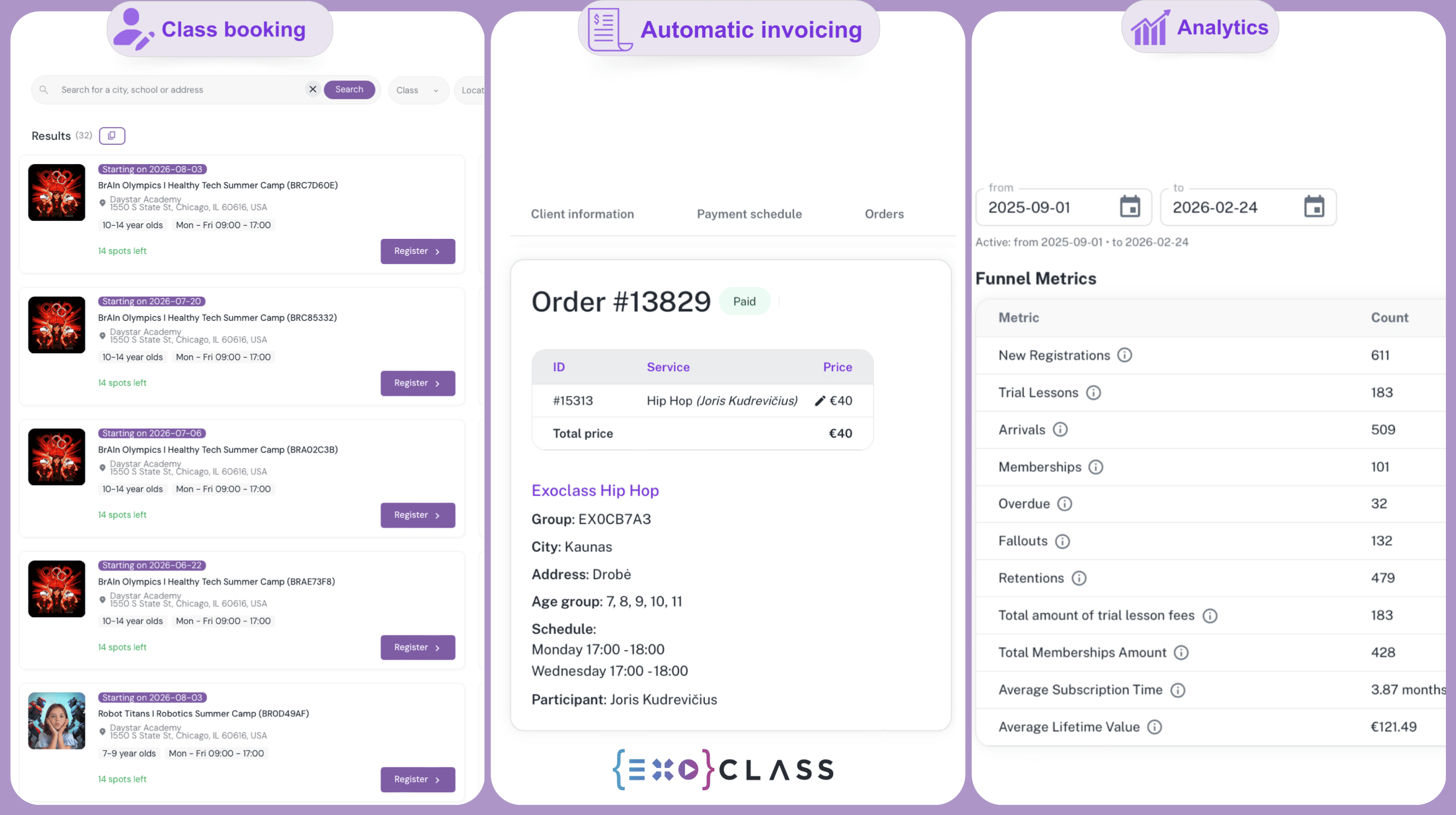
When discussing registration, allocation, and financial stability, what matters most is not individual features—but how they function together. EXOCLASS is designed as a unified music school registration system that connects registration, scheduling, music school invoice payment, and student management into one centralized structure.
The system allows you to:
Manage registrations centrally by instrument, level, and schedule
Integrate music school invoice payment directly into the registration process
Monitor teacher workload and group structure in real time
Store all student management data in a single, unified database
Automate reminders, payments, and communication with parents
Scale operations without proportionally increasing administrative staff
EXOCLASS is not just a registration tool. It is operational architecture that enables a music school to function clearly, consistently, and predictably—even as student numbers grow. When registration, finances, and data control are integrated, school leaders can focus on educational quality, program development, and community growth rather than operational complexity.